|
| Studio portrait of Teresa Wright |
"I only ever wanted to be an actress, not a star."During the early 1940s, few movie actresses made the impact that Teresa Wright did. Wright was Oscar-nominated for the first three movies she appeared in, a record that no other actor or actress has accomplished. Embraced by the public and critics as well, Wright never wanted to be a movie star.
Muriel Teresa Wright was born in 1919 in New York City. After seeing Helen Hayes on the stage, Wright decided she wanted to be an actress. After gaining experience in regional theater, she decided to try her luck on Broadway during the late 1930s.
Early Broadway SuccessAlmost immediately, Wright found herself playing a small role in Thorton Wilder’s
Our Town. During the play’s run, she understudied for Martha Scott, who had the lead role of Emily. When Scott left for Hollywood, Wright stepped into the lead. After her success in
Our Town, she was cast as Mary Skinner in an even bigger success,
Life With Father. During one performance, a talent scout from the Samuel Goldwyn studios noticed something special about Wright.

Goldwyn was looking for someone to play Bette Davis’s daughter in his production of
The Little Foxes, someone who would be able to stand up to the formidable Miss Davis on the big screen. The talent scout thought Teresa Wright was up to the task. Before long, she was brought to Hollywood and signed a long-term contract with Goldwyn.
When
The Little Foxes was released in 1941, Wright was nominated for Best Supporting Actress, alongside Bette Davis who was nominated for Best Actress. The Goldwyn talent scout’s faith in Wright was validated.
Hot PropertySamuel Goldwyn immediately arranged for Wright to costar in William Wyler’s production of
Mrs. Miniver at MGM starring Greer Garson and Walter Pigeon. After she completed that film, she was costarring opposite Gary Cooper in
The Pride of the Yankess, directed by Sam Wood. Both
Mrs. Miniver and The
Pride of the Yankees were released in 1942 and Wright was showered with critical accolades once again.
During that eventful 1942, Wright found herself nominated for both Best Supporting Actress for
Mrs. Miniver and Best Actress for
The Pride of the Yankees! She lost the Best Actress award to Greer Garson, but won the Best Supporting Actress award for her role as Garson’s daughter-in-law.
Hitchcock Comes a CallingWhen director Alfred Hitchcock was casting
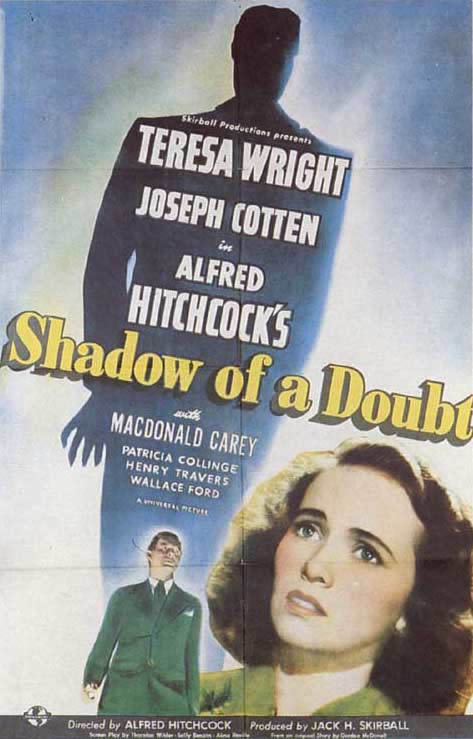
Shadow of a Doubt, he considered Teresa Wright for the lead role of Charlotte (Charlie) Newton. He wanted her for her obvious talent, but Hitchcock also wanted her because she was considered a hot property and her appeal would add to the box office. He was correct on both accounts. From the start Hitchcock was impressed not only with Wright’s talent, but her professionalism on the set. Wright’s characterization is a tour-de-force. She begins the film as a naive, innocent girl and ends it as a mature worldly-wise young woman.
 |
| Wright is top billed in the Hitchcock classic |
During its initial release,
Shadow of a Doubt was a critical and popular success. Today it is considered Hitchcock’s first great American film. Unlike his earlier U.S. movies,
Shadow of a Doubt was set in a small American town populated with average people living seemingly average lives. The notion that innocence and evil live side by side would become a popular theme that Hitchcock would continue to explore in later films.
 |
| Gary Cooper, Wright, and director Sam Wood together again |
A Major StarAfter working with Hitchcock, Wright became a major star, appearing opposite some of Hollywood’s most famous leading men, including Dana Andrews, Robert Mitchum, Ray Milland, and Gary Cooper (after
Pride of the Yankees, they starred together again in
Casanova Brown). During the late 1940s, Wright lost out on two important film roles that hurt her career.
 |
| Pursued is considered the first "psychological" western. |
The Roles That Got AwayWright’s husband, Niven Busch was a screenwriter and popular novelist. He wrote the best-selling novel
Duel in the Sun and adapted the screenplay for producer David O. Selznick. Wright was set to star as the half-breed Pearl Chavez. The role was to be a change of pace for the actress. During production, Wright became pregnant and had to drop out. Jennifer Jones, another actress with a girl-next-door image picked up the role and a Best Actress nomination to boot.
The next role that Teresa Wright lost, again due to pregnancy, was the portrayal of Julia Broughan in
The Bishop’s Wife. The role eventually went to Loretta Young, and again, another box office hit slipped through Wright’s fingers.
You're Fired!
 |
| David Niven and Wright in Enchantment |
In 1948, Wright made a movie for Goldwyn called
Enchantment. Goldwyn had high hopes for the film and Wright had one of the key roles. When production wrapped, Wright didn’t particularly like the result. Scheduled to travel to publicize the film, Wright said she was ill and couldn’t participate. Goldwyn didn’t believe Wright and he fired her. Overnight, Wright was a star without a studio. Used to making $5000 a week and $200,000 per picture, Wright was now a freelance artist during a turbulent time in Hollywood. The major studios were losing money because they were forced to give up their theater ownership, which reaped them huge profits.
Brando's First Leading LadyIn 1950, Wright agreed to star opposite a Hollywood newcomer named Marlon Brando in what would be his very first film,
The Men. The film was an independent low-budget production for which Wright accepted a salary of $25,000. Wright said that after she made that film for that low fee, she was rarely given A-list material again. She still had starring roles in movies, but none matched the quality of her early successes.
Wright Finds Work During Television's "Golden Age"Instead of giving up on acting, Wright started working in TV during its golden age. She was Emmy-nominated for playing Annie Sullivan in a TV production of
The Miracle Worker five years before the film version was made. Later she portrayed famed photographer Margaret Bourke-White in a 1960 TV production.
In addition to her TV work, Wright went back to Broadway starring in
The Country Girl,
Bell, Book and Candle,
The Heiress, and
Death of a Salesman opposite George C. Scott.
During the 1970s, Wright occasionally worked in films and television. During this period she had roles in
Roseland and
Somewhere in Time. Her last major role was playing Miss Birdie, Matt Damon’s landlady, in
John Grisham’s The Rainmaker in 1977.
Teresa Wright died of a heart attack on March 6, 2005. She was 86 years old.
Shadow of a Doubt, one of Wright's most famous roles will be screened at the next "Meet Me at the Movies," Friday October 29, 2010 at 6:30 p.m. at Sherwood Community Music School, Columbia College recital hall, 1312 S. Michigan Ave.
Admission to the movie is $5. After the movie, we'll be meeting at
Little Branch Cafe, 1251 S. Prairie Ave., to discuss the film.
For a synopsis of
Shadow of a Doubt and more information about this classic film, click
here.